Progress Over the Past Weeks
Working on Hive Mind has been a mix of challenges and growth, particularly as I dove deeper into Blender and Unreal Engine. Over the last few weeks, I focused on creating and finalizing the visual representation of the environment for the simulation. This involved designing detailed meshes in Blender and integrating them into Unreal Engine—a process that taught me a lot about balancing visual fidelity and technical requirements.
Blender Learning Journey
Blender has been a fantastic tool for shaping the environment. Creating complex geometry, like ant hills with intricate tunnels, required adding a lot of detail to the mesh. However, this resulted in a high triangle count, which initially caused performance issues in Unreal Engine. Through trial and error, I discovered how to simplify the mesh using Blender’s Decimate Modifier, reducing the file size from 40 MB to just 5 MB while retaining the important details. This optimization made the mesh much more manageable for Unreal Engine.
I’ve grown to appreciate Blender’s flexibility, but I’m also glad we’re nearing the end of setting up the environment. The experience has been rewarding, but I’m excited to move on to the next stages of the project.
NavMesh and Underground Navigation
Early in the project, I planned to use Unreal Engine’s NavMesh system for all navigation. However, after learning more about its limitations, I decided to limit its use to the surface only. The underground tunnels of the ant nests presented unique challenges:
- Some tunnel entrances were too high to be covered properly by the NavMesh.
- The complexity of the underground mesh and its steep transitions made NavMesh less practical.
Instead, I’ll be using trigger boxes for entering and exiting tunnels. When an ant enters a tunnel, a timer will be triggered, and the ant will be teleported to the other side after the set time. This approach simplifies navigation while maintaining realism within the simulation.
Purpose of Ant Nests
Ant nests play a crucial role in the simulation. These nests will serve as:
- Storage Areas: Where food is brought and stored.
- Resting Spots: Where ants recover energy.
- Larvae Care: Where worker ants nurture and care for the larvae, ensuring the colony’s growth.
If you have additional insights into how real-world ant nests function, feel free to share. I’m always open to learning more to improve the simulation’s accuracy.
Vertex Painting for Materials
Another key learning experience was using vertex painting in Unreal Engine. The goal was to differentiate between areas above ground (grass) and below ground (sand). Initially, I considered using the Z-position or face direction to identify underground areas, but this approach didn’t work consistently. Some underground faces pointed upward or had Z-positions higher than the average surface level.
To solve this, I used vertex painting to manually mark underground areas for the sand material. This method allowed for precise control and ensured the materials were applied correctly. It was a bit time-consuming but worth the effort for the level of detail achieved.
Looking Ahead
With the environment visuals nearing completion, I’m feeling re-energized to dive back into coding and gameplay mechanics. The balance of creating and problem-solving in this project has been both rewarding and challenging. As I continue documenting my progress, I’m excited to share more about the simulation’s evolution.
Thanks for following along! Feel free to drop questions, suggestions, or just say hi in the comments. Your feedback means a lot as I continue developing Hive Mind.
Stay tuned for more updates!
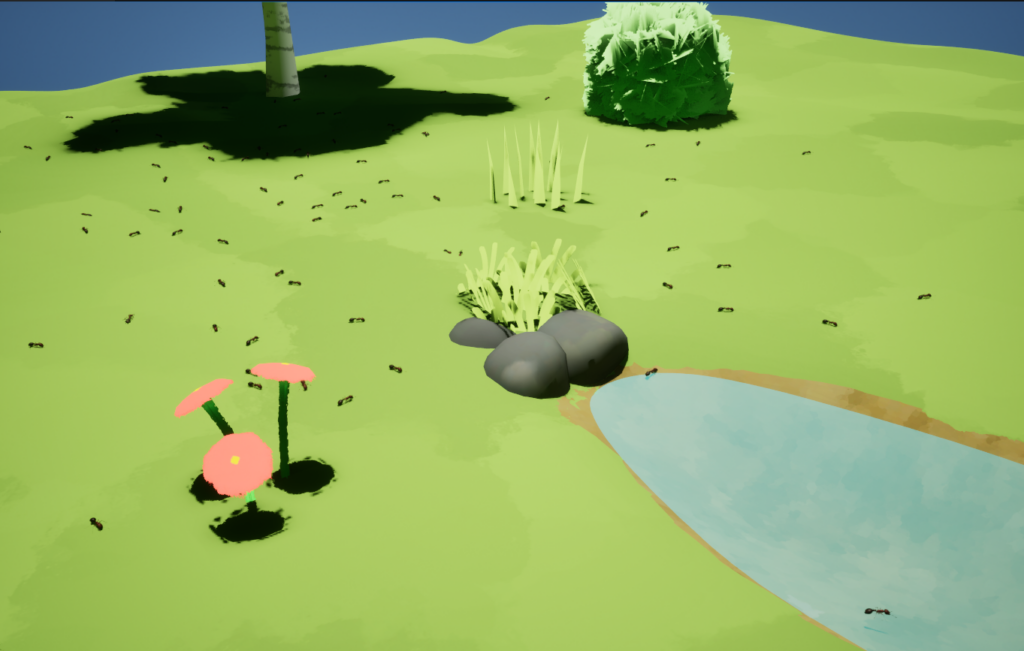
One ant chose even to take a swim
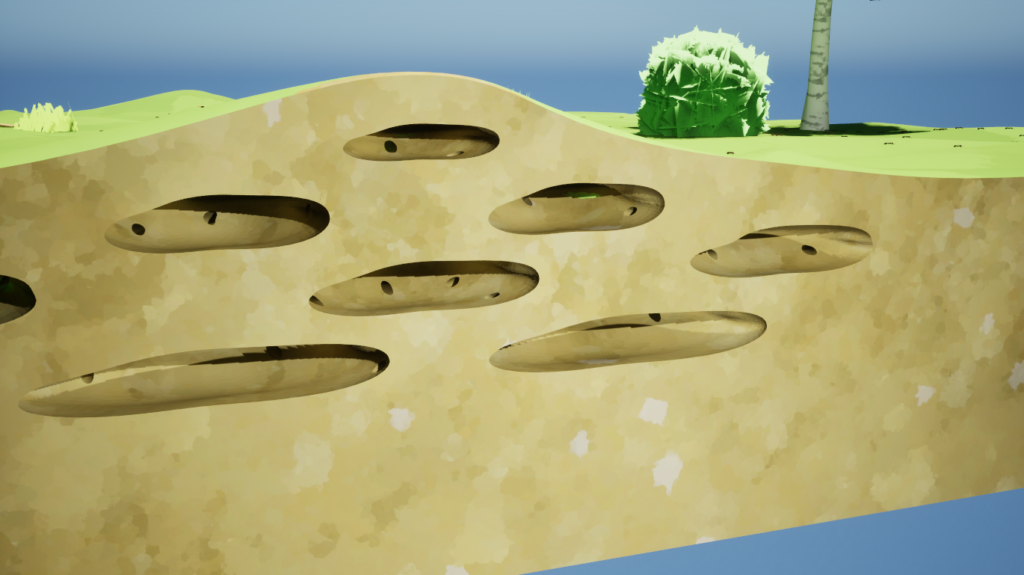
The underground nest chambers which are all connected with tunnels.
Leave a Reply